X-twitter
Share-alt
X-twitter
Linkedin
Facebook
Share-alt
AI is redefining contact centers, not just by automating tasks, but by improving resolution rates, reducing cost per interaction, and enabling consistently personalized customer experiences at scale.
Across industries, contact centers are moving beyond their traditional role as support functions to become critical drivers of consumer loyalty and business performance. Consumers today expect fast, seamless, and personalized interactions across channels, while enterprises must simultaneously control costs and improve productivity.
This pressure is pushing enterprises to rethink how contact centers operate. Incremental improvements such as adding more agents, refining scripts, or expanding channels are no longer sufficient. Enterprises are turning to AI to fundamentally redesign how interactions are managed, measured, and optimized.
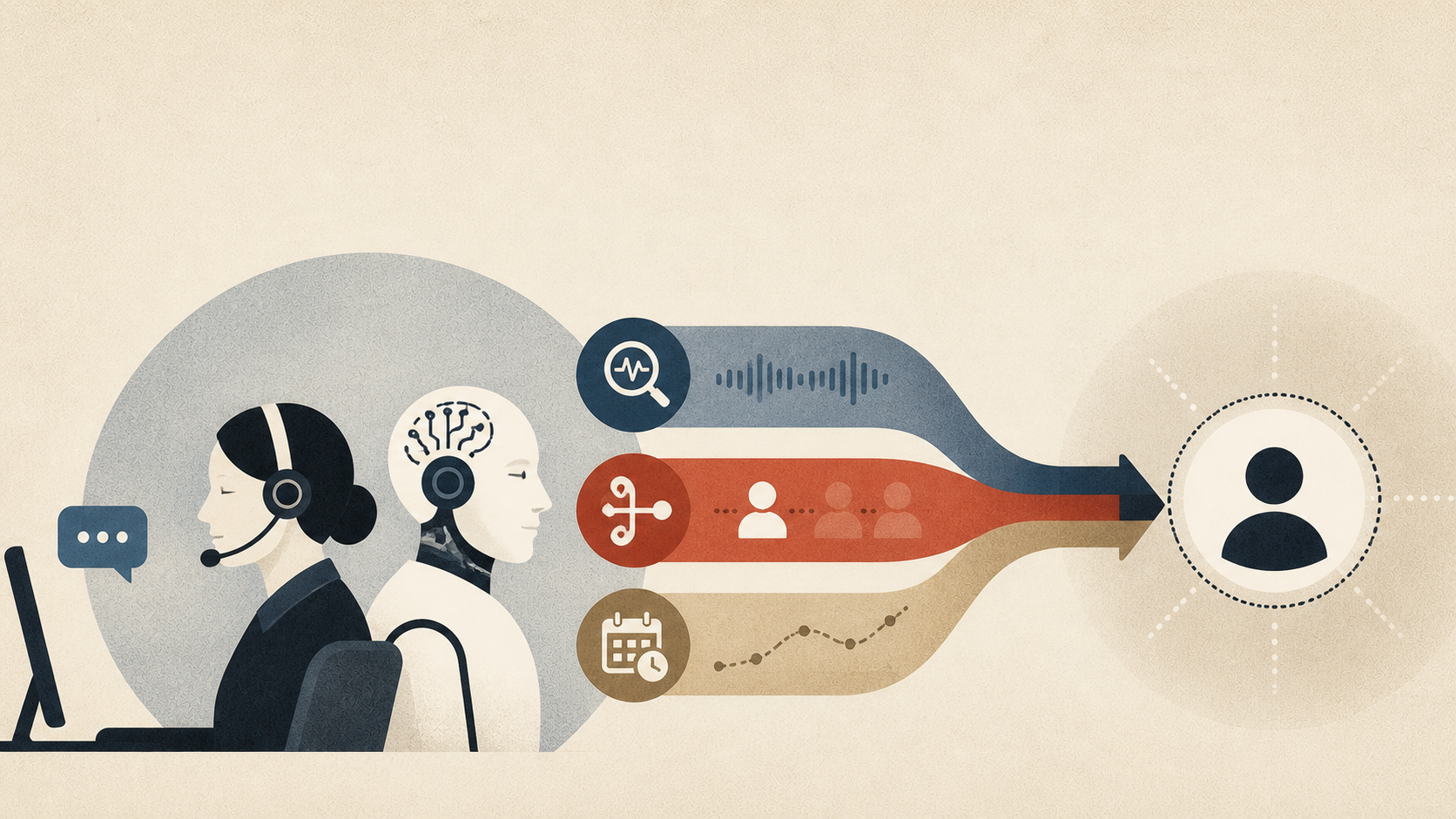
In the broader CRM and CCaaS landscape, leading platforms are embedding AI across the entire customer journey. Rather than treating AI as a standalone feature, the focus is shifting toward integrated intelligence that continuously improves outcomes. Three capabilities are emerging as central to this transformation: AI-powered Quality Management, Intelligent Routing, and AI-driven Forecasting and Scheduling.
Traditional quality management frameworks were built around manual effort and limited visibility. Supervisors reviewed a small sample of interactions, scored them against predefined criteria, and used those insights to guide coaching. While this approach provided some control, it left most consumer interactions unexamined.
As interaction volumes grow and AI agents handle a growing share of conversations, this model becomes insufficient. Enterprises need visibility across the entirety of customer interactions, covering both human and AI-driven engagements, not just a representative sample.
Chatbots · 50+ languages · digital channels
Intelligent IVR · natural language voice
Refunds · Bookings · Zero-Touch Resolution
Renewals · predictive triggers · personalised

·Sample-based reviews covering a fraction of interactions
·Manual scoring against fixed criteria
·Periodic feedback cycles with delayed coaching
·Human-agent evaluation only
·100% interaction analysis across all channels
·Automated AI evaluation at scale
·Continuous real-time insights and coaching
·Human and AI agent performance tracking
A key trend in this space is the rise of hybrid interaction models, where AI agents handle routine queries and human agents focus on complex or emotionally sensitive cases. Intelligent routing ensures seamless transitions between these layers, preserving context throughout.
This shift transforms routing from a backend process into a strategic lever for experience optimization, replacing guesswork with context, intent, and intelligence, while simplifying contact center configurations rather than adding to their complexity.
This dynamic introduces new complexity into forecasting models and demands a new approach to scheduling — one that treats AI and human capacity as a unified planning variable rather than managing them in separate tools. It also demands tighter integration with adjacent capabilities such as quality management, so that insights from how interactions are actually handled feed directly into how the workforce is planned.
Model historical interaction volume, AI agent deflection patterns, and live business signals together in one system.
Forecast when and where human expertise will be required. AI deflection and escalation are modeled natively, not in a separate tool.
Build optimized schedules for both AI and human agents. Intraday reforecasting adapts automatically as conditions change.
·Human-only staffing and planning
·Historical forecasting only
·Fixed, static schedules
·Isolated planning tools
·AI and human workforce managed together
·Predictive and real-time insights combined
·Adaptive, dynamically adjusted scheduling
·Integrated intelligence across the platform
Vendors across the CCaaS market are responding with AI-enabled quality management capabilities that analyze every interaction in real time. These systems detect sentiment, identify intent, flag compliance risks, and surface coaching opportunities automatically.
Routing was designed for a world of fixed rules and predictable customer journeys. Built on static IVR paths, team assignments, and skill-based queues, traditional routing approaches can no longer keep pace with the speed, complexity, and expectations of modern customer engagement.
As customer needs shift in real time, businesses need routing that does more than simply direct interactions. They need routing that can intelligently adapt, align to business priorities, and optimize for custom business outcomes such as conversion, upsell, retention, and other enterprise-specific goals. Without that shift, organizations risk inefficient experiences, rising operational costs, and missed opportunities to deliver exceptional service.
AI-driven routing takes a fundamentally different approach. Rather than relying on hyper-detailed rules and dozens of specialized queues, modern platforms use advanced AI and deep learning models to learn from patterns, rank agents in real time, and create a tailored routing experience for every customer, matching each request to the agent most likely to deliver the best outcome.
Modern forecasting and scheduling capabilities are being designed natively for hybrid AI-human operations. They intelligently analyze how AI agents deflect interactions, predict when human expertise will be required, and empower operations teams to plan staffing with confidence using real-time data and flexible scheduling tools. The outcome is greater budget predictability, more balanced workloads, reduced agent burnout, and consistently strong service quality, even as demand patterns shift.
Enterprises can define the business outcomes that matter most to them and let AI optimize routing accordingly — whether optimizing CSAT, reducing AHT, driving sales, improving first-contact resolution, or tracking a custom KPI. For every interaction, AI evaluates real-time signals such as customer context, agent performance, sentiment, and channel to determine the best possible match. This allows routing decisions to move beyond static logic and become directly aligned to the outcomes each business wants to achieve.
The routing maturity curve
While quality management, routing, and forecasting are each valuable individually, their true impact emerges when they operate as part of a unified system. A key trend across the CCaaS market is the move away from fragmented point solutions toward integrated platforms that share data and intelligence in real time.
Interactions are routed using fixed logic such as team or agent assignments, predefined flows, or basic availability rules. Effective for straightforward scenarios, but limited awareness of customer context — prioritizing distribution over suitability.
Interactions are matched based on predefined skills or attributes. An improvement over simple rules, but still depends on static skill matches that may not reflect real-time performance, customer intent, or changing business priorities.
Interactions are routed using fixed logic such as team or agent assignments, predefined flows, or basic availability rules. Effective for straightforward scenarios, but limited awareness of customer context — prioritizing distribution over suitability.
Rich real-time data connects each customer to the best-suited agent, driving faster resolutions and better experiences.
AI models are tuned to each enterprise’s specific business goals, not generic efficiency metrics.
Automatically adjusts to changing contact volumes, agent availability, and business priorities so performance stays consistent as demand shifts.
Delivers consistent routing across all voice and digital channels for a seamless omnichannel experience.
Built-in static analysis and shadow-mode trials let enterprises compare AI-driven outcomes against legacy routing in a safe, offline environment before going live.
Visual dashboards and analytics give administrators a clear view of performance, support scenario testing, and enable confident deployment of routing improvements.
Powered by Cisco’s Responsible AI Framework, combining ethical AI principles with robust safeguards to ensure fairness, transparency, and compliance.
·Separate tools for QM, routing, and WFM
·Data silos with no shared intelligence
·Delayed insights and manual coordination
·High integration cost and ongoing overhead
·Single platform across all three capabilities
·Shared data layer with real-time feedback loops
·Automated optimization and continuous improvement
·
In fragmented environments, insights from one system take time to influence decisions in another. Unified platforms eliminate that lag: quality insights inform routing decisions, and forecasting models adjust based on live interaction data. For enterprises in India, where scale, complexity, and regulatory requirements are significant, this integrated approach offers a more sustainable path to transformation.
Within this evolving landscape, Cisco stands apart: not as one of many platforms adapting to the AI era, but as one actively defining what an AI-native contact center looks like in practice.
Webex by Cisco was not retrofitted with AI capabilities. It was redesigned for a world where AI agents and human agents operate side by side, where quality management covers every interaction rather than a sample, and where workforce planning accounts for a workforce that is no longer entirely human. This architectural decision — building AI into the platform’s foundation rather than layering it on top — is what separates Cisco from vendors still adapting legacy infrastructure to meet new demands.
What makes this tangible is a unified data layer connecting quality, routing, and forecasting in real time. A quality insight feeds into a coaching action the same day. A shift in routing patterns is reflected in the next scheduling cycle. AI agent performance is continuously monitored and optimized within the same system that manages human agents. There is no lag between observation and action because there is no handoff between systems.
For Indian enterprises, the commitment is concrete: new data centres in Mumbai bring local data residency, lower latency, and the compliance posture that BFSI, healthcare, and public sector organizations require. The results from live deployments speak clearly. CarShield’s deployment of Webex AI Agent now contains 66% of calls without human intervention, compressing resolution times that previously spanned 24 to 48 hours into near-instant outcomes.
Cisco’s approach reflects a clear conviction: the contact center of the future is an AI-native operation where humans and AI work as a unified, continuously improving workforce, and where the platform itself is the intelligence that makes that possible.
100% coverage across AI and human interactions, with automated scoring, real-time coaching, and performance optimization.
CRM-informed, outcome-driven routing across voice, chat, email, and digital channels.
Purpose-built for hybrid AI-human workforces, native to the platform — no separate WFM tool required.
Real-time in-call guidance, transcription, and wrap-up support for human agents.
Autonomous resolution via agentic AI, with A2A and MCP protocols for open integration.
Deep integrations with Salesforce, ServiceNow, AWS, and Microsoft. No rip and replace required.

Webex by Cisco is a leader in cloud-based hybrid work and customer experience technology. Its advanced AI is deeply embedded across the Webex portfolio, most notably in Webex Contact Center, a solution purpose-built for the era of Agentic AI.
Webex Contact Center is an AI-powered, cloud-based platform designed to deliver exceptional customer experiences, improve agent productivity, and drive sustainable business growth. Its AI-native architecture unifies conversational AI, real-time agent assistance, and automated quality management into a single, intelligent system.
As enterprises across India accelerate contact center transformation, Webex by Cisco delivers an AI-native platform built around continuous optimization rather than incremental improvement. Quality management, routing, and forecasting are not standalone capabilities but part of a unified system, connected through a shared data layer that updates in real time.
This allows quality insights to immediately inform routing decisions, while forecasting models dynamically adapt to live interaction patterns and AI-driven deflection rates. Designed for hybrid AI-human operations, the platform enables enterprises to move beyond efficiency metrics toward outcome-driven performance — improving resolution rates, reducing operational costs, and delivering more consistent customer experiences at scale.
Learn more about Webex by Cisco
AI is redefining contact centers, not just by automating tasks, but by improving resolution rates, reducing cost per interaction, and enabling consistently personalized customer experiences at scale.
Across industries, contact centers are moving beyond their traditional role as support functions to become critical drivers of consumer loyalty and business performance. Consumers today expect fast, seamless, and personalized interactions across channels, while enterprises must simultaneously control costs and improve productivity.
This pressure is pushing enterprises to rethink how contact centers operate. Incremental improvements such as adding more agents, refining scripts, or expanding channels are no longer sufficient. Enterprises are turning to AI to fundamentally redesign how interactions are managed, measured, and optimized.
In the broader CRM and CCaaS landscape, leading platforms are embedding AI across the entire customer journey. Rather than treating AI as a standalone feature, the focus is shifting toward integrated intelligence that continuously improves outcomes. Three capabilities are emerging as central to this transformation: AI-powered Quality Management, Intelligent Routing, and AI-driven Forecasting and Scheduling.
Traditional quality management frameworks were built around manual effort and limited visibility. Supervisors reviewed a small sample of interactions, scored them against predefined criteria, and used those insights to guide coaching. While this approach provided some control, it left most consumer interactions unexamined.
As interaction volumes grow and AI agents handle a growing share of conversations, this model becomes insufficient. Enterprises need visibility across the entirety of customer interactions, covering both human and AI-driven engagements, not just a representative sample.

Chatbots · 50+ languages · digital channels
Intelligent IVR · natural language voice
Refunds · Bookings · Zero-Touch Resolution
Renewals · predictive triggers · personalised

·Sample-based reviews covering a fraction of interactions
·Manual scoring against fixed criteria and empathy in distressed situations
·Periodic feedback cycles with delayed coaching
·Human-agent evaluation only

·100% interaction analysis across all channels
·Automated AI evaluation at scale
·Continuous real-time insights and coachingt
·Human and AI agent performance tracking
Vendors across the CCaaS market are responding with AI-enabled quality management capabilities that analyze every interaction in real time. These systems detect sentiment, identify intent, flag compliance risks, and surface coaching opportunities automatically.
Routing was designed for a world of fixed rules and predictable customer journeys. Built on static IVR paths, team assignments, and skill-based queues, traditional routing approaches can no longer keep pace with the speed, complexity, and expectations of modern customer engagement.
As customer needs shift in real time, businesses need routing that does more than simply direct interactions. They need routing that can intelligently adapt, align to business priorities, and optimize for custom business outcomes such as conversion, upsell, retention, and other enterprise-specific goals. Without that shift, organizations risk inefficient experiences, rising operational costs, and missed opportunities to deliver exceptional service.
AI-driven routing takes a fundamentally different approach. Rather than relying on hyper-detailed rules and dozens of specialized queues, modern platforms use advanced AI and deep learning models to learn from patterns, rank agents in real time, and create a tailored routing experience for every customer, matching each request to the agent most likely to deliver the best outcome.
Enterprises can define the business outcomes that matter most to them and let AI optimize routing accordingly — whether optimizing CSAT, reducing AHT, driving sales, improving first-contact resolution, or tracking a custom KPI. For every interaction, AI evaluates real-time signals such as customer context, agent performance, sentiment, and channel to determine the best possible match. This allows routing decisions to move beyond static logic and become directly aligned to the outcomes each business wants to achieve.

Interactions are routed using fixed logic such as team or agent assignments, predefined flows, or basic availability rules. Effective for straightforward scenarios, but limited awareness of customer context — prioritizing distribution over suitability.
Interactions are matched based on predefined skills or attributes. An improvement over simple rules, but still depends on static skill matches that may not reflect real-time performance, customer intent, or changing business priorities.
Interactions are matched to the agent best suited for the desired business outcome. Using real-time customer context and agent insights, AI routing continuously adapts to optimize for goals like conversion, upsell, retention, and other custom KPIs — without adding configuration complexity.
Rich real-time data connects each customer to the best-suited agent, driving faster resolutions and better experiences.
AI models are tuned to each enterprise’s specific business goals, not generic efficiency metrics.
Automatically adjusts to changing contact volumes, agent availability, and business priorities so performance stays consistent as demand shifts.
Delivers consistent routing across all voice and digital channels for a seamless omnichannel experience.
Built-in static analysis and shadow-mode trials let enterprises compare AI-driven outcomes against legacy routing in a safe, offline environment before going live.
Visual dashboards and analytics give administrators a clear view of performance, support scenario testing, and enable confident deployment of routing improvements.
Powered by Cisco’s Responsible AI Framework, combining ethical AI principles with robust safeguards to ensure fairness, transparency, and compliance.
A key trend in this space is the rise of hybrid interaction models, where AI agents handle routine queries and human agents focus on complex or emotionally sensitive cases. Intelligent routing ensures seamless transitions between these layers, preserving context throughout.
This shift transforms routing from a backend process into a strategic lever for experience optimization, replacing guesswork with context, intent, and intelligence, while simplifying contact center configurations rather than adding to their complexity.
This dynamic introduces new complexity into forecasting models and demands a new approach to scheduling — one that treats AI and human capacity as a unified planning variable rather than managing them in separate tools. It also demands tighter integration with adjacent capabilities such as quality management, so that insights from how interactions are actually handled feed directly into how the workforce is planned.
Model historical interaction volume, AI agent deflection patterns, and live business signals together in one system.
Forecast when and where human expertise will be required. AI deflection and escalation are modeled natively, not in a separate tool.
Build optimized schedules for both AI and human agents. Intraday reforecasting adapts automatically as conditions change.
·Human-only staffing and planning
·Historical forecasting only
·Fixed, static schedules
·Isolated planning tools
·AI and human workforce managed together
·Predictive and real-time insights combined
·Adaptive, dynamically adjusted scheduling
·Integrated intelligence across the platform
Modern forecasting and scheduling capabilities are being designed natively for hybrid AI-human operations. They intelligently analyze how AI agents deflect interactions, predict when human expertise will be required, and empower operations teams to plan staffing with confidence using real-time data and flexible scheduling tools. The outcome is greater budget predictability, more balanced workloads, reduced agent burnout, and consistently strong service quality, even as demand patterns shift.
While quality management, routing, and forecasting are each valuable individually, their true impact emerges when they operate as part of a unified system. A key trend across the CCaaS market is the move away from fragmented point solutions toward integrated platforms that share data and intelligence in real time.
·Separate tools for QM, routing, and WFM
·Data silos with no shared intelligence
·Delayed insights and manual coordination
·High integration cost and ongoing overhead
·Single platform across all three capabilities
·Shared data layer with real-time feedback loops
·Automated optimization and continuous improvement
·Lower total cost of ownership and faster deployment
In fragmented environments, insights from one system take time to influence decisions in another. Unified platforms eliminate that lag: quality insights inform routing decisions, and forecasting models adjust based on live interaction data. For enterprises in India, where scale, complexity, and regulatory requirements are significant, this integrated approach offers a more sustainable path to transformation.
Within this evolving landscape, Cisco stands apart: not as one of many platforms adapting to the AI era, but as one actively defining what an AI-native contact center looks like in practice.
Webex by Cisco was not retrofitted with AI capabilities. It was redesigned for a world where AI agents and human agents operate side by side, where quality management covers every interaction rather than a sample, and where workforce planning accounts for a workforce that is no longer entirely human. This architectural decision — building AI into the platform’s foundation rather than layering it on top — is what separates Cisco from vendors still adapting legacy infrastructure to meet new demands.
What makes this tangible is a unified data layer connecting quality, routing, and forecasting in real time. A quality insight feeds into a coaching action the same day. A shift in routing patterns is reflected in the next scheduling cycle. AI agent performance is continuously monitored and optimized within the same system that manages human agents. There is no lag between observation and action because there is no handoff between systems.
For Indian enterprises, the commitment is concrete: new data centres in Mumbai bring local data residency, lower latency, and the compliance posture that BFSI, healthcare, and public sector organizations require. The results from live deployments speak clearly. CarShield’s deployment of Webex AI Agent now contains 66% of calls without human intervention, compressing resolution times that previously spanned 24 to 48 hours into near-instant outcomes.
Cisco’s approach reflects a clear conviction: the contact center of the future is an AI-native operation where humans and AI work as a unified, continuously improving workforce, and where the platform itself is the intelligence that makes that possible.
100% coverage across AI and human interactions, with automated scoring, real-time coaching, and performance optimization.
CRM-informed, outcome-driven routing across voice, chat, email, and digital channels.
Purpose-built for hybrid AI-human workforces, native to the platform — no separate WFM tool required.
Real-time in-call guidance, transcription, and wrap-up support for human agents.
Autonomous resolution via agentic AI, with A2A and MCP protocols for open integration.
Deep integrations with Salesforce, ServiceNow, AWS, and Microsoft. No rip and replace required.
Webex is a leader in cloud-based hybrid work and customer experience technology. Its advanced AI is deeply embedded across the portfolio, most notably in Webex Contact Center, a solution purpose-built for the era of Agentic AI.
Webex Contact Center is an AI-powered, cloud-based platform designed to deliver exceptional customer experiences, improve agent productivity, and drive sustainable business growth. Its AI-native architecture unifies conversational AI, real-time agent assistance, and automated quality management into a single, intelligent system.
This enables organizations to move beyond fragmented point solutions and orchestrate end-to-end customer journeys, where AI agents handle high-volume interactions at scale, and human agents step in with full context when empathy and judgment are required. With a shared intelligence layer across automation, assistance, and analytics, Webex ensures every interaction is connected, contextual, and continuously improving.
Learn more about Webex by Cisco