AI IN CUSTOMER EXPERIENCE
Balancing 24/7 AI Agents with AI-Assisted Human Agents
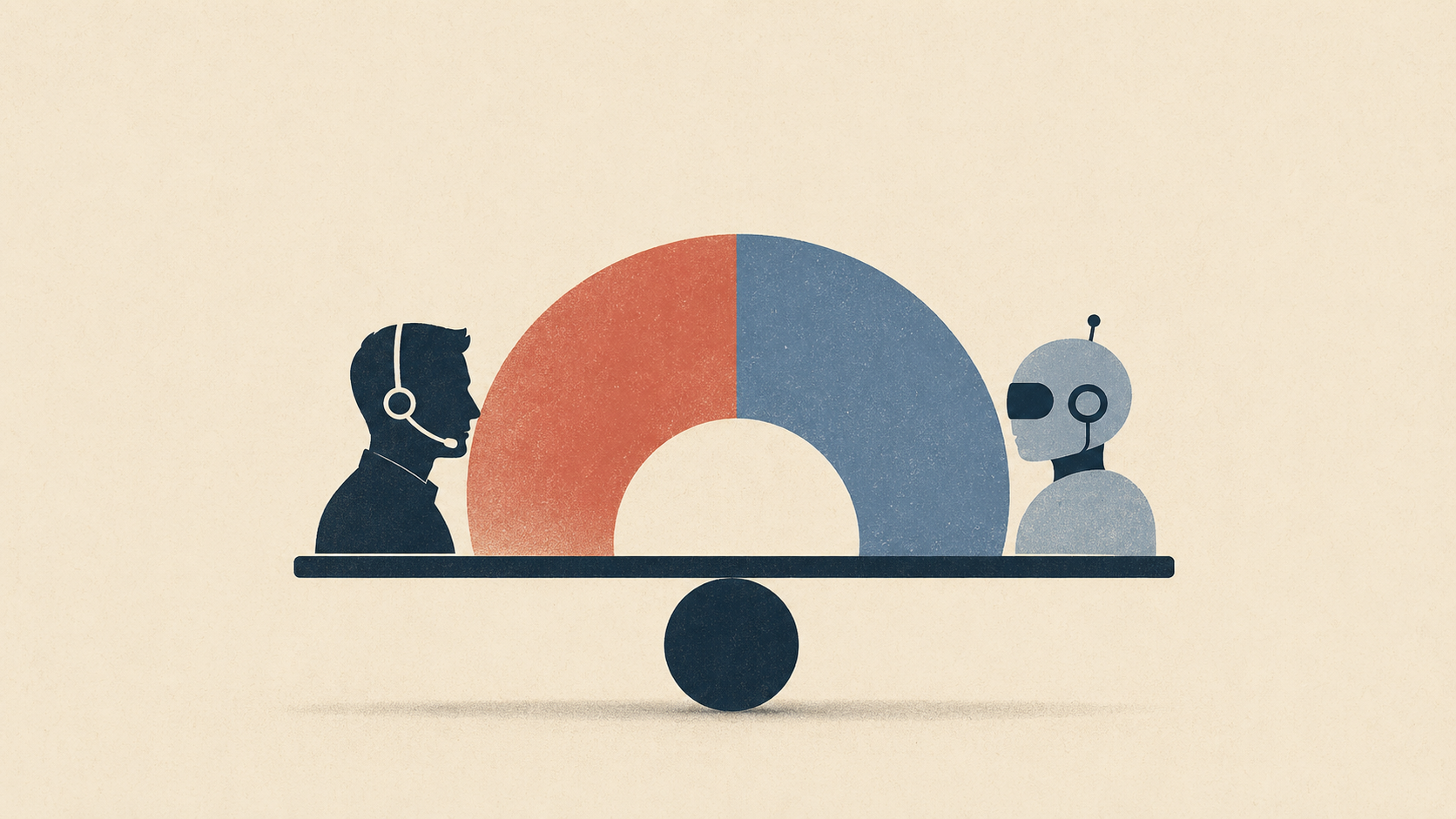
AI Agents | Autonomous Layer
24/7 availability · Instant resolution . Infinite
scale
Handles high-volume interactions autonomously across voice and digital channels, freeing human agents for what only they can do.
Human + AI Assist | Empathy Layer
Real-time guidance · Context continuity ·
Empathy
Complex resolution and relationship-building, every agent powered by the Cisco AI Assistant in real time.
The Imbalance in Modern CX
India’s digital-first shift has redefined what consumers expect. Simplicity, speed, personalisation, and round-the-clock availability are no longer differentiators, they are the baseline. Yet most contact centres remain constrained by human-only scale.
Three structural pressures are driving Indian CX leaders towards an orchestrated model:
- Always-on demand: Consumers across metro and tier-2 cities expect service beyond business hours, on every channel.
- Agent burnout: Repetitive query overload drives attrition, leaving gaps where empathy and judgment matter most.
- Rising digital expectations: Tolerance for friction has reached near zero; consumers benchmark against global leaders.
The Rise of 24/7 AI Agents
AI Agents represent the automation layer of modern CX, purpose-built to handle high-volume, structured interactions without fatigue. These agents resolve consumer queries autonomously using natural language across both voice and digital channels, enabling always-on service at scale.
Add Your Heading Text Here
Add Your Heading Text Here
AI Agents support both fully autonomous and guided self-service, integrating with back-office systems to fulfil consumer intent in real time. Increasingly, they are also evolving toward multi-agent ecosystems, where different AI agents collaborate with each other and with enterprise systems to complete complex tasks securely and efficiently.
Human Agents Under Pressure
Human agents remain irreplaceable for complex, emotionally charged interactions requiring empathy, judgment, and relationship-building. But when they spend most of their time on repetitive, structured queries, two things happen: burnout rises, and quality suffers.
Where human agents excel
- Complex problem-solving requiring multi-step reasoning.
- Emotional intelligence and empathy in distressed situations
- Relationship building and trust establishment
- Judgment calls where context and nuance matter
- De-escalation of frustrated or high-value consumers
What creates pressure
- Repetitive, high-volume queries consuming shift capacity
- No real-time guidance during complex calls
- Context lost at handoffs, consumer must repeat themselves
- Manual after-call wrap-up adding to workload
- Attrition and burnout from unbalanced query mix
The Hybrid CX Model
The hybrid CX model is not a compromise between automation and human service. It is a deliberate orchestration of both designed so that every interaction is handled by the right resource, at the right moment, with full context preserved throughout.
The model operates in three coordinated movements:
1. Autonomous first contact
AI Agents handle initial engagement across voice and digital channels, resolving high-volume queries or intelligently routing based on intent, complexity, and customer value, 24/7.
2. Intelligent escalation with full context
When human judgment is required, the transition is immediate and context rich. Conversation history, intent, and prior actions are passed seamlessly, eliminating repetition and reducing friction for both the consumer and the agent.
3. AI-assisted human resolution
Human agents take over complex or sensitive interactions, supported by real-time AI guidance, summarisation, and decision support, enabling faster resolution while preserving empathy and relationship quality.
AI-Native vs Bolt-On: The Difference That Matters
Most contact centre platforms were not built for AI. They evolved from call routing systems, ticketing engines, and collaboration tools, with AI added incrementally over time.
The result is a fragmented architecture: AI and human workflows operate in silos, context breaks at handoffs, and data is distributed across disconnected systems. Supervisors manage performance across multiple dashboards that do not share a common intelligence layer.
This is not a surface-level inefficiency, it is an architectural constraint. AI-native platforms operate fundamentally differently. They process context during the interaction itself, enabling real-time routing, live agent guidance, and immediate action. Intelligence is embedded into the workflow, not applied after the fact.
The direction of the market reinforces this shift. Leading CCaaS players are converging on AI-native architectures, embedding intelligence directly into the service lifecycle rather than layering it on top.
Across the industry, three patterns are emerging:
- Resolution over deflection: Success is increasingly measured by first contact resolution and end-to-end task completion, rather than containment or deflection metrics.
- Unified orchestration: Routing, agent assistance, and analytics operate on a shared intelligence layer, reducing fragmentation and enabling consistent decisioning across the interaction lifecycle.
- AI across the lifecycle: From self-service to assisted service and quality management, AI is embedded end-to-end, enabling continuity of context and intelligence across every stage of the customer journey.
What differentiates platforms now is not the presence of AI, but how deeply it is embedded into the system, whether intelligence flows across every interaction or remains confined to isolated modules.
How Cisco enables Hybrid CX Model
Webex Contact Center is built as a unified system where AI agents, human assistance, and analytics share a single intelligence layer, so context flows across every interaction.
1. Layer 1: AI Agent (Autonomous resolution)
Handles first contact across channels, resolving or routing with full intent captured and action taken in real time.
2. Layer 2: AI Assistant (Human support)
Guides agents during live interactions with real-time suggestions, summaries, and next-best actions, no context loss, no repetition.
3.Layer 3: AI Quality Management (Continuous learning)
Evaluates 100% of interactions and feeds insights back into routing, guidance, and workflows.
Shared intelligence layer: All layers operate on the same data foundation, so every interaction improves the system, not just individual components.
Why This Matters Now: Webex by Cisco in India
For Indian enterprises, the hybrid CX imperative is especially urgent. India’s contact centre industry is one of the largest in the world. The push toward AI-native CX is accelerating, driven by rising digital adoption, regulatory evolution, and the need to scale without proportionally scaling headcount.
Cisco is bringing Webex Contact Center to India
Mumbai data centre
Webex Contact Center services hosted locally is now available. High performance, reduced latency, and full local infrastructure enabling Indian enterprises and multinationals to run cloud CX without data leaving the country.
Local data residency
Consumer data stays within Indian borders, meeting telecom regulatory requirements and enterprise privacy expectations. Local hosting also delivers enhanced call quality and reduced latency.
Regulatory compliance
Built to meet India’s specific regulatory and privacy requirements. Enterprises operate on Webex with the assurance of local compliance, enterprise-grade security, and the flexibility to scale without re-architecting.
Partner Spotlight

Webex is a leader in cloud-based hybrid work and customer experience technology. Its advanced AI is deeply embedded across the portfolio, most notably in Webex Contact Center, a solution purpose-built for the era of Agentic AI.
Webex Contact Center is an AI-powered, cloud-based platform designed to deliver exceptional customer experiences, improve agent productivity, and drive sustainable business growth. Its AI-native architecture unifies conversational AI, real-time agent assistance, and automated quality management into a single, intelligent system.
This enables organizations to move beyond fragmented point solutions and orchestrate end-to-end customer journeys, where AI agents handle high-volume interactions at scale, and human agents step in with full context when empathy and judgment are required. With a shared intelligence layer across automation, assistance, and analytics, Webex ensures every interaction is connected, contextual, and continuously improving.
Learn more about Webex by Cisco
More like this
Get the India AI-CX Readiness Report 2025 today
Authored by Twimbit. Research commissioned by Cisco’s Webex. Designed for CX leaders, IT heads, and digital transformation teams across India.